When you hold a smartphone, drive a car, or rely on medical equipment to keep someone alive, you probably never stop to think about how every single component fits together so precisely. The tolerances involved are often smaller than a human hair. Behind that precision is a discipline most people outside the industry rarely hear about manufacturing metrology.
It’s not a flashy term. It doesn’t trend on social media. But without it, modern manufacturing would fall apart, quite literally.
What Is Manufacturing Metrology?
At its core, metrology is the science of measurement. Manufacturing metrology, specifically, is the application of precise measurement techniques to the production of parts, components, and assemblies in industrial settings.
It answers one essential question: Is what we made actually what we designed?
Every part that comes off a production line has a set of specifications — dimensions, tolerances, surface finish, geometric form. Manufacturing metrology is the process of verifying that reality matches the blueprint. And when it doesn’t, metrology tells you exactly how far off you are and in which direction.
This isn’t just about quality control at the end of a production run. Modern metrology is embedded throughout the manufacturing process — from raw material inspection to in-process checks to final product verification.
Why Manufacturing Metrology Matters More Than Ever
The Shrinking Tolerance Window
Thirty years ago, a tolerance of ±0.1 mm was considered tight. Today, in industries like aerospace, semiconductor manufacturing, and medical devices, tolerances can be measured in nanometers — billionths of a meter. As products get smaller, faster, and more complex, the margin for error shrinks accordingly.
Without sophisticated metrology systems, manufacturers simply cannot hit these targets consistently. And inconsistency is expensive.
The Cost of Getting It Wrong
Consider what happens when a single component in an aircraft engine is slightly out of spec:
- The engine may not perform to rated efficiency
- Vibration and wear increase over time
- In the worst case, catastrophic failure becomes a possibility
In automotive manufacturing, a misaligned body panel isn’t just cosmetic. It affects aerodynamics, noise levels, and seal integrity. In medical implants, dimensional error can cause implant failure inside a patient’s body.
The cost of defects in high-stakes manufacturing isn’t just financial — it can be a matter of life and death.
Core Tools and Techniques in Manufacturing Metrology
Manufacturing metrology relies on a wide and growing toolkit. Here’s a breakdown of the most commonly used measurement technologies:
Coordinate Measuring Machines (CMMs)
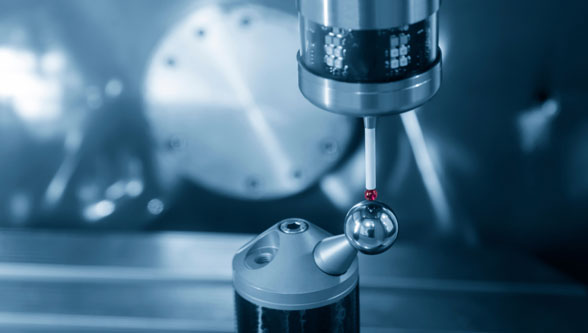
CMMs are the workhorses of dimensional metrology. A CMM uses a probe — either contact or non-contact — to measure the precise coordinates of points on a part’s surface. The collected data is then compared against a CAD model to verify dimensional accuracy.
Key advantages of CMMs:
- Extremely high accuracy, often to within microns
- Can measure complex 3D geometries
- Widely accepted in aerospace and automotive quality systems
- Can be automated for high-volume production
Modern CMMs range from tabletop units used in small machine shops to massive gantry systems that measure entire aircraft fuselages.
Optical and Vision Measurement Systems
Where contact probes might damage delicate parts or simply be too slow, optical systems step in. These use cameras, lasers, and structured light to capture surface geometry without ever touching the part.
Common optical methods include:
- Laser triangulation for surface profiling
- Structured light scanning for full 3D capture
- Machine vision cameras for 2D feature inspection on production lines
- Interferometry for measuring surface finish and flatness to nanometer resolution
Surface Roughness Measurement
A part might have the right shape but the wrong surface. Surface metrology focuses on the texture and finish of a surface — critical in applications where friction, sealing, or fatigue life are concerns.
Why surface finish matters:
- Too rough, and a sealing surface leaks
- Too smooth, and a bearing surface won’t hold lubricant
- Incorrect finish on a fatigue-critical aerospace component can reduce service life dramatically
Profilometers — both contact stylus and non-contact optical types — are the primary tools for surface finish measurement.
Hardness Testing
While dimensional metrology gets the most attention, material properties also need verification. Hardness testing is one of the most common material metrology checks, used to verify that heat treatment processes have achieved the correct material properties.
Gauge and Fixture Inspection
Not every measurement happens on a high-tech CMM. In many production environments, custom gauges and fixtures provide fast, repeatable go/no-go checks on the shop floor. These tools are simpler but highly effective for high-volume production where speed matters.
In-Process vs. Post-Process Metrology
One of the most important strategic decisions in manufacturing metrology is when to measure.
Post-Process Inspection
The traditional approach: make the part, then inspect it. While this is still common, it has a significant drawback — by the time you find a problem, you may have already made thousands of bad parts.
In-Process Metrology
Increasingly, manufacturers are embedding measurement directly into the production process. Sensors, probes, and vision systems on CNC machines allow parts to be measured while they’re still being machined.
Benefits of in-process metrology:
- Defects are caught immediately, not after the fact
- Machine tool corrections can be applied in real time
- Scrap and rework rates drop significantly
- Cycle time and cost per part decrease over time
This approach is a cornerstone of closed-loop manufacturing, where measurement data feeds back into the process to continuously correct and optimize production.
Metrology in the Age of Industry 4.0
Manufacturing metrology is being transformed by the same digital forces reshaping the entire industry.
Digital Twins and Virtual Inspection
A digital twin is a virtual replica of a physical part or production process. Measurement data captured from real parts is fed into the digital twin, allowing engineers to compare actual vs. intended performance in a simulated environment. This is particularly powerful in predicting how dimensional variations affect product performance — before a single product reaches a customer.
AI and Machine Learning in Defect Detection
Traditional inspection often relied on human inspectors or simple rule-based systems. Today, AI-powered vision systems can:
- Identify defects that are invisible to the human eye
- Learn from thousands of inspection results to improve accuracy over time
- Flag anomalies and predict process drift before defects appear
- Dramatically increase inspection speed on high-volume lines
Cloud-Based Quality Data
Measurement data generated on the shop floor is increasingly being stored in cloud-based quality management systems. This means:
- Quality trends can be tracked across multiple production sites globally
- Engineers anywhere can access real-time inspection data
- Statistical process control (SPC) is applied automatically across thousands of measurements
- Regulatory reporting and traceability documentation is simplified
Standards and Calibration: The Foundation of Trust
Metrology is only as good as the standards it’s built on. For a measurement to mean anything, it has to be traceable to a recognized international standard.
International Standards in Manufacturing Metrology
- ISO 10360 — defines acceptance testing and reverification for CMMs
- ISO 1101 — governs Geometric Dimensioning and Tolerancing (GD&T)
- ISO 286 — covers limits and fits for cylindrical parts
- ASME Y14.5 — the widely used American standard for GD&T
Calibration
Every measurement instrument drifts over time. Temperature changes, mechanical wear, and environmental conditions all affect accuracy. Regular calibration — comparing instruments against certified reference standards — keeps measurement systems trustworthy.
Most manufacturers maintain calibration schedules and records as part of their quality management systems, and many industries require it for regulatory compliance.
Industries Where Manufacturing Metrology Is Mission-Critical
While metrology is important across all manufacturing sectors, some industries depend on it more intensely than others:
- Aerospace — turbine blades, structural components, and fasteners must meet tolerances where failure is not an option
- Automotive — engines, transmissions, and safety systems require consistent dimensional control across millions of parts
- Medical devices — implants, surgical instruments, and diagnostic equipment are subject to strict dimensional and surface requirements
- Semiconductor manufacturing — circuit features measured in nanometers demand the most precise measurement systems on the planet
- Energy — turbines, valves, and pressure vessels in power generation require precise measurement to ensure efficiency and safety
The Human Side of Metrology
Behind the machines and software, manufacturing metrology remains a deeply human discipline. Skilled metrologists interpret measurement results, design inspection plans, troubleshoot process problems, and make judgment calls that no algorithm can fully replace.
The best metrology professionals understand not just how to take a measurement, but what the measurement means — how a particular deviation affects part function, what it tells you about the process that made it, and what action is appropriate in response.
This blend of technical knowledge, engineering intuition, and problem-solving skill makes metrology one of the more intellectually demanding roles in manufacturing.
Final Thoughts
Manufacturing metrology doesn’t make headlines. You won’t see it celebrated in product launches or marketing campaigns. But every time a jet engine performs flawlessly at 35,000 feet, every time a medical implant improves someone’s quality of life, and every time a car door closes with a satisfying thud — metrology played a role in making that possible.
It is, in every sense, the science that keeps manufacturing honest. And as products grow more complex and tolerances tighter, its importance will only continue to grow.