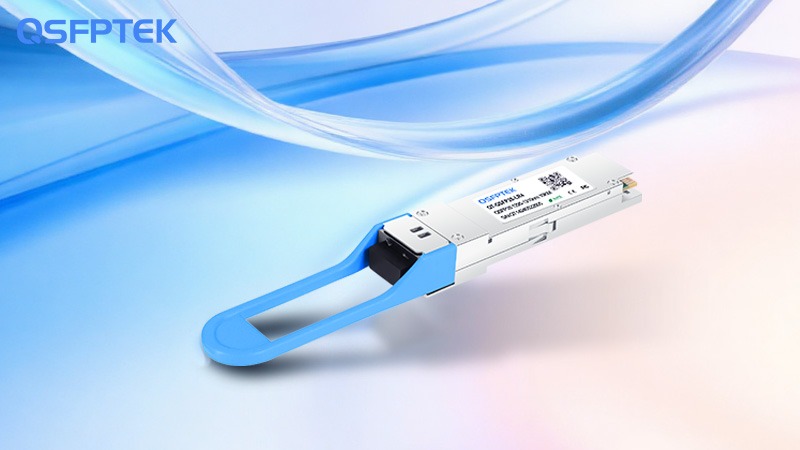
As enterprise and data center networks continue to scale, the limitations of 40G Ethernet are becoming increasingly apparent. What was once sufficient for aggregation and core layers now struggles to support modern workloads such as cloud computing, virtualization, large-scale storage, and east-west traffic growth. As a result, many organizations are planning upgrades to 100G Ethernet as a practical next step. Within the range of available 100G solutions, QSFP28 LR4 has emerged as a logical and widely adopted option for long-reach, high-capacity network links.
In real-world upgrade scenarios, 100G QSFP28 modules often serve as the foundation for moving beyond 40G without introducing unnecessary complexity. They provide a balance between bandwidth, reach, and operational familiarity, making them particularly attractive to organizations that already rely on single-mode fiber infrastructure. Among these modules, QSFP28 LR4 stands out for its ability to support 100G transmission over distances of up to 10 kilometers using standard LC duplex single-mode fiber.
The Challenges of Staying with 40G Networks
Growing Bandwidth Demands
40G Ethernet was originally designed to address aggregation and backbone requirements in an earlier phase of data center evolution. However, traffic patterns have shifted dramatically. Today’s networks are dominated by east-west traffic driven by distributed applications, microservices, and virtualization. These workloads generate sustained, high-throughput data flows that quickly saturate 40G links, creating bottlenecks that affect performance and scalability.
As server access speeds increase and storage systems demand higher throughput, maintaining 40G in core or aggregation layers can limit overall network efficiency. Upgrading to 100G allows organizations to consolidate links, reduce oversubscription, and better align network capacity with modern application requirements.
Limitations of 40G Optical Options
From a physical layer perspective, many 40G deployments rely on QSFP+ modules such as SR4 or LR4. While these technologies have proven reliable, they often lack the flexibility and density required by newer network architectures. In some cases, 40G LR4 deployments already use single-mode fiber, making them natural candidates for a straightforward transition to 100G LR4 without major changes to cabling infrastructure.
Why 100G Is the Natural Upgrade Path
Performance and Port Density Advantages
Moving from 40G to 100G Ethernet delivers an immediate increase in bandwidth efficiency. A single 100G link can replace multiple 40G connections, simplifying network design and reducing the number of physical interfaces required. This consolidation not only improves port density on switches but also lowers operational complexity by reducing the total number of transceivers and fiber connections.
In modern spine-leaf architectures, 100G has become the de facto standard for spine-to-leaf connectivity. Compared to 40G, it provides the capacity needed to support higher server densities and more demanding workloads without frequent redesigns of the network fabric.
Understanding QSFP28 LR4 Technology
How QSFP28 LR4 Delivers 100G Over Distance
QSFP28 LR4 modules achieve 100G transmission by combining four 25G optical lanes using coarse wavelength division multiplexing (CWDM) in the 1310 nm wavelength range. These four wavelengths are transmitted over a single pair of single-mode fibers using an LC duplex connector, allowing for efficient use of existing fiber infrastructure.
With a maximum reach of up to 10 kilometers, QSFP28 LR4 is well suited for inter-building connections, campus networks, and long-reach data center interconnects. This distance capability distinguishes it from short-reach 100G options such as SR4, which are limited to multimode fiber and much shorter distances.
Advantages of QSFP28 LR4 in 40G to 100G Upgrades
Reusing Existing Single-Mode Fiber Infrastructure
One of the strongest arguments for choosing QSFP28 LR4 when upgrading from 40G is the ability to reuse existing single-mode fiber cabling. Many 40G LR4 deployments already operate over single-mode fiber with LC connectors. Transitioning to 100G LR4 in these environments often requires minimal physical changes, significantly reducing upgrade costs and deployment time.
This compatibility allows organizations to focus investment on switch upgrades rather than cabling replacement, making the transition more predictable and less disruptive. For networks with long-distance links, this reuse of fiber infrastructure is a decisive advantage.
Operational Familiarity and Reliability
QSFP28 LR4 builds on technologies that network operators are already familiar with from 40G LR4 deployments. Similar connector types, fiber requirements, and optical principles reduce the learning curve for installation and troubleshooting. Additionally, the inclusion of digital diagnostic monitoring enables real-time visibility into parameters such as optical power, temperature, and voltage, supporting proactive maintenance and improved reliability.
Comparing QSFP28 LR4 with Other 100G Options
Why LR4 Makes Sense for Long-Reach Upgrades
While there are multiple 100G optical options available, not all are equally suitable for replacing 40G in long-reach scenarios. Short-reach modules such as 100G SR4 are optimized for intra-data-center connections over multimode fiber but cannot support distances beyond a few hundred meters. Other options, such as ER4, offer longer reach but at a higher cost and with stricter optical requirements.
QSFP28 LR4 occupies a practical middle ground by offering sufficient reach for most enterprise and metro applications while maintaining a balanced cost profile. This makes it a logical choice for organizations seeking to modernize their networks without overengineering the solution.
Practical Deployment Considerations
Planning a Smooth Transition
A successful upgrade from 40G to 100G using QSFP28 LR4 requires careful planning but does not necessarily involve complex changes. Verifying fiber quality, ensuring adequate optical power budgets, and confirming switch compatibility are key steps in the process. When these factors are addressed, QSFP28 LR4 can be deployed as a drop-in upgrade in many existing environments.
Conclusion
Upgrading from 40G to 100G is no longer a question of if, but when. As network demands continue to grow, 100G Ethernet provides the capacity and efficiency required to support modern applications and architectures. Among the available 100G solutions, QSFP28 LR4 stands out as a logical choice for organizations seeking a smooth, cost-effective transition.
By offering long reach, compatibility with existing single-mode fiber infrastructure, and proven reliability, QSFP28 LR4 enables networks to evolve without unnecessary disruption. For enterprises and data centers looking to future-proof their connectivity while maximizing the value of existing investments, QSFP28 LR4 represents a practical and strategic path forward.