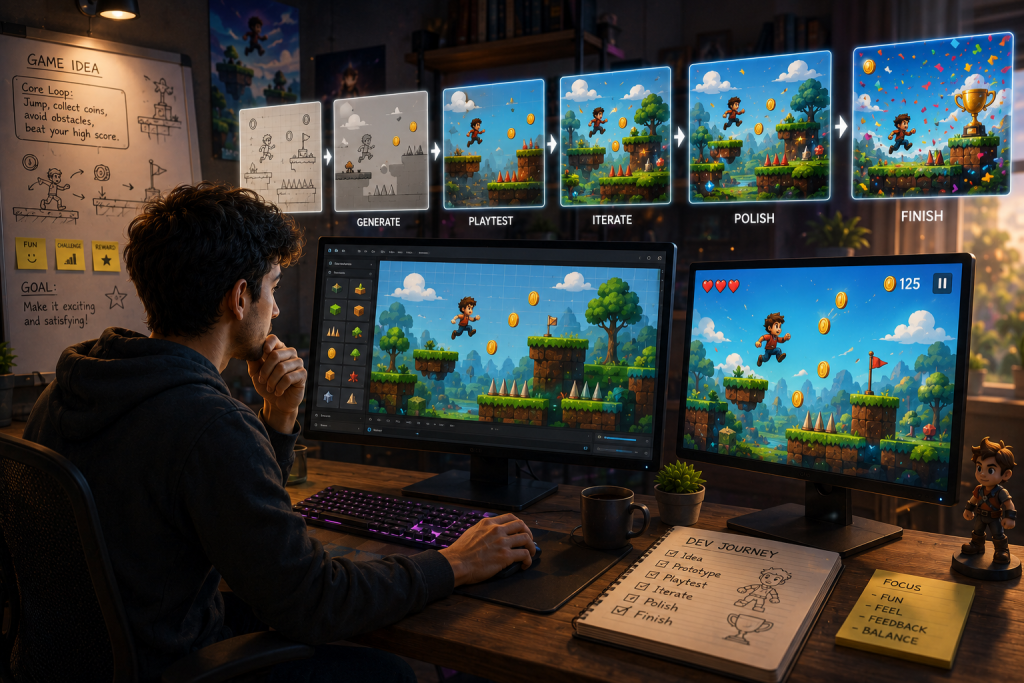
There’s a specific moment a lot of first-time creators hit: a genuinely good idea for a game, and no idea how to actually build it. That gap used to end most game ideas before they went anywhere. It doesn’t have to anymore. Creating your own game without coding is a realistic, complete process now, not a watered-down alternative to “real” development.
Here’s exactly how to go from an idea sitting in your head to something people can actually play.
Why Coding Was Never the Real Barrier
Coding was always just the mechanism for translating an idea into something functional. It was never the creative part. The actual value in a game, what makes it fun, what makes players want to keep going, comes from design decisions: pacing, difficulty, feedback, and the feel of the core action. Removing the coding requirement doesn’t remove any of the creative work. It just removes the layer that used to sit between having an idea and testing it.
Getting Clear on Your Idea Before You Build Anything
Define the Core Action
Every good game comes down to one repeated action the player performs. Jumping, matching, building, dodging. Before opening any tool, be able to describe that action in a single sentence. If you can’t, the idea probably needs more thinking before it needs building.
Know What Makes It Fun
Beyond just describing the action, understand why it would be satisfying. Is it the timing? The risk-reward tension? The visual payoff? Games like Jump for Millions work because the core tension, deciding when to commit versus when to hold back, is immediately clear and immediately felt. That kind of clarity should guide your own idea before you generate anything.
Keep the Scope Small
First projects that try to do too much rarely get finished. Pick one mechanic and commit to making that one thing feel great, rather than spreading effort across several half-built systems.
Turning Your Idea Into a Playable Game
Describe It in Plain Language
Instead of a blank code editor, you start with a description. What does the player do? What’s the goal? What happens when they succeed or fail? No-code game maker platforms take that description and turn it into a working prototype, giving you something playable almost immediately instead of a long technical build process.
Play the Rough Version Honestly
Resist tweaking before you’ve actually played the first version. Experience it as generated so you know what’s genuinely working and what needs to change, rather than guessing based on how it read on paper.
Adjust Based on What You Feel, Not What You Assumed
The gap between what you imagined and what you got is useful information. Maybe the pacing feels off. Maybe a mechanic that sounded exciting in your head feels flat in practice. Let actual play, not assumption, guide your next changes.
Refining Your Game Into Something Good
Change One Thing at a Time
When adjusting difficulty, pacing, or a specific mechanic, isolate each change and test it individually. Adjusting multiple things simultaneously makes it hard to know what’s actually improving the experience.
Get Someone Else to Play It
Watch someone unfamiliar with your project try it, ideally within the first week. Their confusion, hesitation, and genuine reactions reveal things you’ve stopped noticing after staring at your own game repeatedly.
Polish Once the Core Feels Right
Once the central mechanic is genuinely satisfying, shift your attention to feel: tightening controls, adjusting timing, improving feedback when the player succeeds or fails. This is where a decent prototype becomes something people actually want to keep playing.
Common Mistakes First-Time Creators Make
Adding Features Before the Core Loop Works
It’s tempting to keep adding ideas once building feels easy. Resist this until your core mechanic is confirmed to be fun on its own. Extra systems built on a shaky foundation rarely fix the underlying problem.
Skipping Playtesting Because It Feels Finished
A generated version that plays smoothly can feel done even when it isn’t. Real playtesting, especially from people outside your own head, catches problems that internal judgment alone tends to miss.
Assuming the First Version Is the Final Version
Treat your first playable build as a draft. Expect to adjust, retest, and refine several times before the game feels the way you actually want it to.
A Simple Path From Idea to Finished Game
- Write your core loop in one sentence.
- Describe it in plain language and generate a rough version.
- Play it immediately, without adjusting first.
- Change one element at a time and retest after each change.
- Get outside feedback within the first week.
- Polish feel and timing once the core mechanic holds up.
- Set a finish line and ship it, even if it’s small.
Final Thoughts
Creating your own game without coding isn’t a compromise. It’s a complete, legitimate path that removes technical execution as the thing standing between an idea and a playable version of it. What still determines whether the result is actually good is the same as it’s always been: a clear concept, honest playtesting, and the discipline to refine based on how the game actually feels, not just how it sounded when you first thought of it.
Start with something small enough to finish. Everything else, the polish, the depth, the confidence to build something bigger next time, comes from actually seeing that first idea through to the end.