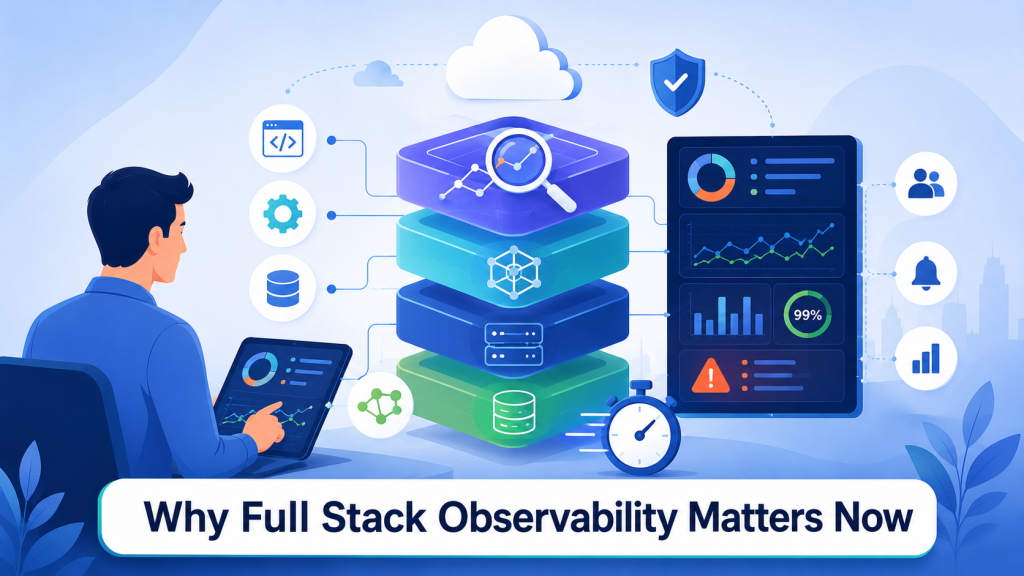
A payment delay does not start as a security incident. It might begin with a failed container deployment, spread into API latency, put pressure on backend systems and only then expose a weakness that looks, on the surface, like an attack. Tracing that chain across five separate dashboards takes time the business does not have. This is the gap full stack observability is built to close.
Full stack observability brings together infrastructure, applications, networks, cloud workloads and user experience data into one connected view, rather than scattering them across disconnected monitoring tools. For security and engineering teams running distributed, multi-cloud environments, that correlation changes how quickly an issue gets found and fixed. This blog looks at why that matters, where the value shows up and how organisations are putting it into practice.
What Full Stack Observability Actually Covers
The term gets used loosely, often as a synonym for better dashboards. In practice, full stack observability refers to correlated visibility across five specific layers: infrastructure, applications and services, security monitoring, digital experience and log management. Missing any one of those leaves a blind spot somewhere in the stack, even if the rest looks well monitored.
It is less about buying another tool and more about connecting telemetry that, in most companies, already exists but sits in separate systems. A cloud platform’s metrics, an application’s traces and a SIEM’s security logs can each be accurate on their own and still tell three incomplete stories when nobody links them.
Why Visibility Has Become Harder to Achieve
Modern application stacks rarely sit in one place. A typical enterprise runs workloads across a dozen cloud platforms alongside legacy on-premise systems, and each layer generates its own logs, metrics and traces. Security tools, performance monitors and cloud-native services all produce data that rarely speaks to others.
Recent industry research found that a large share of organisations still lack genuine full-stack visibility, leaving parts of their technology stack unmonitored. The usual culprits are complex, sprawling architectures and too many siloed monitoring tools feeding separate dashboards. Engineers end up switching between systems mid-incident, piecing together a narrative while the underlying problem keeps growing.
How Full Stack Observability Changes the Response
When telemetry from across the stack sits in one correlated view, the time spent identifying root cause drops sharply. Security and operations teams are not waiting on a second or third tool to confirm what the first one suggested. They see the failed deployment, the latency spike and the unusual login attempt as parts of the same event rather than three unrelated alerts.
That speed has a direct financial dimension. High-impact outages carry a steep median cost per hour, and organisations with mature full-stack visibility report markedly lower costs during those same incidents. The gap is not about better dashboards. It comes down to how much manual correlation a team has to do before they can act.
Core Benefits Worth Highlighting
Before listing them individually, it helps to set the context – each of these benefits stems from the same underlying shift, moving from scattered monitoring towards a single, connected source of data across the entire stack.
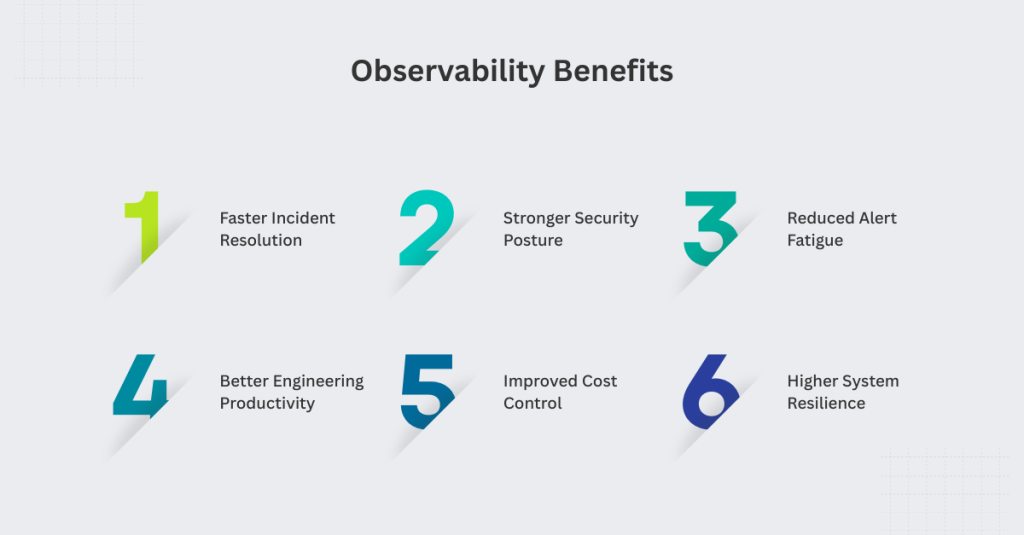
- Faster Incident Resolution: Correlated logs, metrics and traces mean less time spent jumping between tools and more time spent on the actual fix.
- Stronger Security Posture: Unusual traffic patterns, failed logins and anomalous API behaviour surface earlier, often before they escalate into a confirmed breach.
- Reduced Alert Fatigue: Consolidating telemetry around business impact, rather than raw volume, helps teams discard noise and focus on alerts that matter.
- Better Engineering Productivity: Surveyed engineers report spending a third of their time firefighting and another third on maintenance. Connected observability cuts into both.
- Improved Cost Control: FinOps, SecOps and DevOps teams working from the same dataset make sharper decisions about where spend is actually going.
- Higher System Resilience: Dependencies between hybrid cloud systems become visible before a small failure cascades into a wider outage.
Where Full Stack Observability Fits in a Security Strategy
Observability and security used to sit in different conversations. That separation is becoming harder to justify. Tools combining performance indicators with security telemetry can flag a sudden traffic surge or a string of failed login attempts as a potential DDoS attempt or unauthorised access, instead of treating it purely as a performance anomaly.
1. Detecting Threats Earlier in the Chain
A security event rarely announces itself cleanly. It tends to show up first as a performance symptom: slower response times, an unexpected spike in resource use or a service that starts behaving oddly under load. Full Stack Observability gives security teams the context to recognise these early signals instead of waiting for a confirmed alert from a separate SIEM platform.
2. Supporting Zero Trust and Distributed Architectures
As organisations expand API-driven services and zero trust models, the number of components that need watching grows accordingly. Observability platforms that span the full stack make it possible to keep that expanding surface area under continuous, contextual watch rather than relying on point solutions that only see one slice of it.
Common Barriers for OrganisationsCommon Barriers for Organisations
Adoption is not always straightforward. Complex technology stacks remain the most frequently cited obstacle, closely followed by tool sprawl and siloed data sitting in disconnected systems. Newer services and frameworks add telemetry volume faster than most teams can rationalise it, which means the fragmentation problem can quietly get worse even while observability spend goes up.
There is also a communication gap. Many technical teams understand the operational case for Full Stack Observability but struggle to translate it into the language boards respond to: revenue continuity, customer experience and measurable risk reduction. Without that translation, budget conversations tend to stall on cost before anyone discusses value.
Conclusion
Full Stack Observability is no longer a monitoring upgrade sitting quietly inside an IT budget line. It is becoming the layer that decides how quickly a team spots a problem, how clearly they understand its scope and how much it ends up costing the business once it is resolved. Organisations running distributed, multi-cloud environments stand to gain the most, provided the visibility is genuinely connected rather than another set of disconnected dashboards.
CyberNX can help build that connected view through its full stack observability solutions, bringing performance and security data together into one operational picture aligned to how your environment actually runs. If your organisation is dealing with fragmented monitoring tools or slow incident response, connect with their experts to see how full-stack visibility can fit into your security strategy.